


 David Schwartz
For landlords and property managers, water costs can become a significant expense, especially across apartment and multifamily properties where the owner pays the building’s water and sewer bills.
Leaks and inefficient fixtures are common sources of waste, but they are not the only factors that can affect what a property pays. Water pressure, flow conditions, meter performance, and the way water moves through the building’s main supply line can also contribute to unnecessary costs.
This is where a Smart Valve can play a role. It provides a building-level way to manage some of these conditions. Installed within the main water supply system, the right type of valve can help property owners control water flow more effectively without relying entirely on residents to change their daily habits.
So, how does a smart valve help reduce water bills, and when does it make sense for landlords and multifamily properties?
What Is a Smart Valve?
.webp?width=500&height=333&name=Inner%20Image%20(1).webp)
A Smart Valve is a water flow management device installed in a property's main water line to provide greater control over water moving through the supply line.
However, not every smart water valve works in the same way. Some use sensors and connected technology to detect leaks and automatically shut off the water when unusual activity occurs. Others function as a water flow control device, helping manage pressure, flow, or other conditions within the water supply.
For landlords, the key is understanding what the valve actually controls and which source of water waste or cost it is designed to address.
How Does a Smart Valve Work?
The working pattern depends on the type of valve. A leak-detection valve monitors water-use patterns and closes the supply when it identifies a possible leak. Meanwhile, a flow-management valve may regulate how water moves through the main line or respond to changing pressure and demand.
In apartment and multifamily properties, a main-line smart valve can help manage water before it reaches individual units. This makes it different from low-flow showerheads, faucet aerators, or toilet devices, which control water use at a specific fixture.
Both approaches can support water conservation, but they solve different problems within the property.
How Does a Smart Valve Help Reduce Water Bills?
A smart valve can help reduce water bills by giving property owners greater control over how water enters and moves through the building. The exact savings depend on the type of valve being used, but reducing unnecessary water use can affect both water and wastewater costs.
According to EPA WaterSense, average U.S. commercial water and wastewater rates totaled $13.36 per 1,000 gallons, including $6.13 for water and $7.23 for wastewater. For properties using large volumes of water, even incremental reductions in unnecessary consumption can therefore add up over time.
1. Managing Excessive Water Flow
Fixtures do not always need the maximum amount of water the supply system can deliver.
If more water is moving through faucets, showers, and other fixtures than necessary during normal use, the additional volume can increase overall consumption without creating an equivalent benefit for residents.
Certain water-management valves help control these conditions at the main supply level.
For a multifamily property, even small reductions repeated across many units and throughout the day can add up over time.
2. Managing Water Pressure
Higher pressure can cause more water to flow through a fixture during the same amount of use.
For example, when two residents run a faucet for the same length of time, the fixture receiving significantly higher flow may use more water even though their behavior is identical.
Depending on its design, a water conservation valve can help manage system pressure or flow so the property is not consistently supplying more water than necessary.
The goal is not to create poor water pressure for residents. The goal is to balance usable water delivery with more efficient consumption.
3. Reducing Water Oversupply
Water oversupply can happen when the incoming system delivers more water than a fixture or application requires.
Across one faucet, that difference may seem minor. Across an entire apartment complex, the cumulative effect can become much larger.
A properly selected and calibrated water-saving valve can help reduce unnecessary oversupply while keeping the system functional during normal and peak demand.
4. Providing Building-Level Water Control
One of the main advantages of a whole-building valve is that it can support water management across multiple units from a single point in the plumbing system.
This makes a smart valve for multifamily buildings particularly relevant for landlords managing multiple units under one water account.
5. Reducing Dependence on Resident Behavior
Resident education can help with conservation, but landlords cannot control how long every tenant showers, how often faucets are left running, or whether residents consistently think about water efficiency.
Mechanical water conservation solutions provide another layer of control.
Once the right system is installed and properly calibrated, its performance does not depend entirely on residents remembering to conserve water every day.
Can a Smart Valve Reduce Water Consumption?
Yes, certain types of smart valves can help reduce water consumption, but the result depends on what the valve is designed to do.
A device that manages excessive pressure or flow may reduce the amount of water delivered during normal fixture use. A leak-detection smart valve may reduce waste by identifying leaks earlier or shutting off the supply when a major leak occurs.
These are different methods, but both can contribute to lower consumption.
It is also important to look at the entire property.
A smart valve cannot correct every source of water waste. A running toilet still needs to be repaired or controlled. An inefficient shower fixture may still use more water than necessary. Hidden leaks still require attention.
For this reason, building-level flow management works best as part of a broader water conservation plan that also addresses toilets, showers, leaks, maintenance, and fixture efficiency.
|
Paying Too Much for Water and Sewer? Take greater control of water use across your property and reduce unnecessary utility expenses.
|

Smart Valve Benefits for Landlords and Multifamily Properties
|
Benefit |
Why It Matters |
|
Building-level control |
Helps address water conditions before water reaches individual units |
|
Lower water consumption |
Certain valves can help limit unnecessary flow or oversupply |
|
Less reliance on residents |
Conservation does not depend entirely on behavioral changes |
|
Scalable approach |
Useful for properties with many apartments or fixtures |
|
Potential sewer savings |
Lower metered water use may also reduce sewer charges where the two are connected |
|
Better cost control |
Recurring utility savings can help reduce property operating expenses |
For multifamily owners, lower utility expenses can also support higher net operating income.
That is one reason water conservation solutions should be evaluated based on both the gallons they may save and the recurring operating costs they may reduce.
Where Is a Smart Valve Installed?
Smart Valve installation depends on the type of valve and the plumbing system.
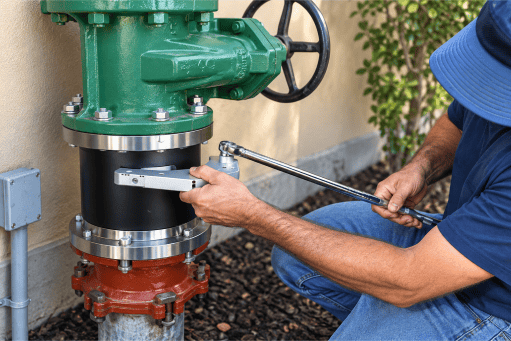
Whole-building flow-management valves are generally installed within the main water supply line so they can affect water before it is distributed throughout the property.
The exact position depends on the device, the building's plumbing configuration, existing pressure-control equipment, the water meter, backflow prevention equipment, pipe diameter, and other site conditions.
Installation should follow the manufacturer's specifications.
For commercial or multifamily applications, professional installation is especially important because the valve may need to be sized and calibrated around the property's pressure and peak water demand.
A valve should never be adjusted simply to maximize restriction. Residents still need sufficient water pressure when multiple fixtures are operating at the same time.
The objective is controlled, efficient water delivery without compromising normal building operation.
How Much Can a Smart Valve Save on Water Bills?
There is no universal answer to how much a smart valve can save on water bills. Results depend on the technology, property size, water usage, pressure conditions, local water and sewer rates, existing plumbing, and how efficiently the building already operates.
For example, a property with excessive flow or pressure may have a greater opportunity for savings than a property where water delivery is already closely controlled. The financial impact also depends on the property's current utility expenses.
If a building spends $50,000 per year on water and sewer, even a moderate percentage reduction can create meaningful recurring savings. The same percentage reduction at a smaller property would naturally result in lower dollar savings.
Rising utility rates also make water conservation increasingly important. According to Bluefield Research, U.S. household water and sewer bills increased 5.1% in 2025 and 24.2% over the previous five years, based on its analysis of 50 major U.S. cities.
For landlords and property managers, this means unnecessary water use can become more expensive over time as rates continue to rise. Therefore, reducing avoidable consumption today can help control both current and future operating costs.
The next step is identifying a solution designed specifically for the water conditions affecting the property.
How The Water Scrooge™ Smart Valve Takes Water Flow Control Further
The Water Scrooge™ Smart Valve is designed specifically as a building-level water flow control device.
Unlike connected smart valves that primarily focus on leak detection or automatic shutoff, The Water Scrooge™ Valve uses a patented Variable Flow Control process based on pressure and fluid dynamics. The company designed it to address water meter accuracy and excessive water consumption within the supply system.
It Compresses Air Before It Reaches the Water Meter
According to The Water Scrooge™, air can be present within the volume moving through a property's water supply.
The Smart Valve does not remove this air. Instead, it compresses the air before it reaches the water meter. After it moves through the meter and valve, the air returns to its original state. The company states that this process can help prevent the meter from measuring that compressed air volume as part of consumption.
This is a product-specific function of The Water Scrooge™ Smart Valve and should not be assumed to apply to every smart water valve.
It Helps Keep the Water Meter Within Its Designed Flow Range
The valve is also designed to prevent pressure changes caused by water use from reaching the meter and to keep the meter operating within its designed flow range.
The manufacturer also states that the valve can reduce water oversupply caused by higher-than-desired city pressure.
Together, these functions address both meter-related conditions and unnecessary water delivery.
It Can Be Adjusted to the Property
The Smart Valve is externally adjustable.
During calibration, the valve setting can be increased while downstream pressure is monitored. The goal is to find the strongest practical setting without causing an unacceptable pressure drop or affecting normal water use in the building.
This matters because every property has different flow and pressure requirements.
If those conditions change later, the valve can also be adjusted rather than automatically requiring replacement.
It Is Installed Near the Water Meter
The Water Scrooge™ Smart Valve is installed on the user side of the water meter.
Its installation instructions recommend placing it before devices such as a pressure reducer or booster pump, with a location shortly after the backflow preventer often being suitable. Installation should be completed by a licensed plumber or mechanical engineer.
Threaded and flanged configurations are available to suit different plumbing systems.
Take Greater Control of Your Property's Water Costs
The Water Scrooge™ states that the Smart Valve can reduce water bills by 15% to 20% by improving water meter accuracy. For landlords, this provides another way to control water costs without relying only on fixture upgrades or resident behavior.
For apartment and multifamily properties with significant water and sewer expenses, even a moderate recurring water bill reduction can make a meaningful difference to overall operating costs.
|
Reduce Your Water Costs at the Source If your property is paying more for water than it should, address the problem before that cost keeps adding up.
|
