


 David Schwartz
According to the U.S. Environmental Protection Agency (EPA), showering accounts for nearly 17% of residential indoor water use. That makes the shower a practical place to reduce avoidable water consumption. One common solution is installing a shower head flow restrictor. It’s a small device that limits how much water passes through a showerhead each minute.
Some restrictors use a fixed opening, while others respond to changes in water pressure. That difference can matter in apartment buildings, where pressure may vary between floors and units.
So, what does a shower head flow restrictor do, and how is it different from a low-flow shower head or regulator? Let’s break it down.
What Is a Shower Head Flow Restrictor?
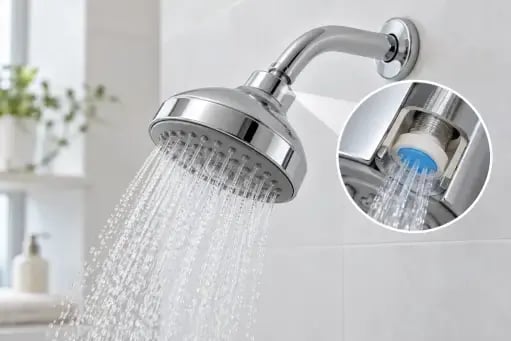
A shower head flow restrictor is a small component designed to reduce the volume of water that can pass through a showerhead in a given amount of time. It may be built into the showerhead, positioned near the inlet, or installed elsewhere in the shower water line. Many conventional models use a small opening to limit flow.
You will hear it called by a lot of different names, like shower flow restrictor, shower head water restrictor, shower head water saver, water flow restrictor for shower head, or shower head flow regulator. These terms are often used interchangeably, but there can be an important technical difference.
A basic restrictor generally creates a fixed limitation on flow. A regulator may be designed to react to changes in line pressure, so water flow remains more controlled under different conditions.
In a multifamily property, that difference can affect how consistently showers perform across the building.
How Does a Shower Head Flow Restrictor Work?
To understand how a shower head flow restrictor works, picture water traveling from the supply pipe toward the showerhead. A basic restrictor introduces a smaller passage into that path. Because less water can pass through the opening at once, the showerhead flow rate decreases.
In simple terms:
Water supply → restricted passage → controlled flow → showerhead spray
If shower duration stays the same, reducing gallons per minute reduces the total amount of water used.
For example, a 10-minute shower at 2.5 gallons per minute uses up to 25 gallons. At 2.0 GPM, the same 10-minute shower uses 20 gallons.
On the other hand, pressure-controlling devices work differently. Instead of relying only on one fixed opening, they are designed to respond to changes in incoming pressure and regulate water flow more consistently. Such devices are mainly useful in properties where pressure varies between units.
Understanding Shower Head Flow Rate and GPM
GPM stands for gallons per minute. It describes how much water passes through the showerhead each minute.
For a 10-minute shower:
|
Shower Head Flow Rate |
Approx. Water Used |
|
2.5 GPM |
25 gallons |
|
2.0 GPM |
20 gallons |
|
1.8 GPM |
18 gallons |
|
1.5 GPM |
15 gallons |
In the United States, federal standards generally limit showerheads to a maximum flow rate of 2.5 GPM. WaterSense-labeled showerheads must use no more than 2.0 GPM and also meet EPA performance requirements for factors such as spray force and coverage.
However, lower shower head water flow does not automatically mean better performance. A shower water saving device should reduce water use while still delivering a practical shower experience.
Shower Head Flow Restrictor vs. Low Flow Shower Head
A shower head flow restrictor and a low-flow shower head can both reduce water use, but they are not the same thing.
A low-flow shower head is a complete fixture designed to operate at a lower flow rate. Its nozzles, spray pattern, and internal components may all be engineered around a specific GPM.
A flow restrictor is a component that limits water moving through a fixture or line. It may be built into the showerhead or installed separately.
Replacing the entire showerhead may make sense when fixtures are old. A separate flow-control device may be more practical when existing showerheads are still usable.
For landlords, accessibility also matters. If a flow-limiting insert is easy for residents to reach, it may be removed or altered, making expected savings harder to maintain across multiple units.

What Are the Benefits of a Shower Flow Restrictor?
A properly selected shower flow restrictor can support several water-management goals.
- Reduced Water Consumption: Less water passes through the shower during the same amount of time. Even a modest reduction in GPM can add up when multiplied across many showers and units.
- Lower Hot Water Demand: Most showers use heated water. Reducing shower volume can therefore reduce the amount of water that must be heated and delivered.
- Potentially Lower Utility Costs: If a property owner pays for water, sewer, or central hot water, reducing unnecessary shower use may help lower operating expenses. Actual savings depend on utility rates, occupancy, shower duration, current flow rates, and the equipment installed.
- Less Dependence on Resident Behavior: A mechanical shower head water saver controls flow automatically. That means conservation depends less on residents remembering to take shorter showers.
However, reducing water use often raises another important question: does limiting flow also affect how much pressure users feel at the showerhead?
Does a Flow Restrictor Reduce Shower Water Pressure?
Flow and pressure are related, but they are not the same thing.
Water pressure is the force pushing water through the plumbing. Flow rate is the amount of water passing through a point over time.
A shower head flow restrictor primarily controls flow. However, reducing flow can change how the shower feels, especially when a basic restrictor is paired with a showerhead that does not perform well at a lower rate.
The EPA has noted that simply adding flow-control inserts to inefficient showerheads may produce poor performance in some facilities. That is why the goal should not be to create the smallest possible opening. Instead, it should be to select the product after proper consideration of flow rate, pressure, showerhead design, and the regulating device together.
Flow Restrictor vs. Flow Regulator: What Is the Difference?
A fixed restrictor and a pressure-compensating regulator are not technically identical.
A simple restrictor has a fixed passage. The amount of water flowing through it can still change when incoming water pressure changes. While a pressure-compensating shower head flow regulator responds to those pressure changes to keep flow more consistent.
This matters in apartment buildings, where pressure can vary between floors or change throughout the day.
For property owners, that means choosing a solution based only on advertised GPM may not be enough. How the device manages changing pressure can also affect performance.
Why Conventional Shower Flow Restrictors Can Be a Challenge for Landlords
Managing one shower is very different from managing dozens or hundreds.
Many conventional restrictors are installed inside the showerhead, making them relatively easy to access. A resident who wants greater showerhead water flow may be able to remove or alter the insert. Fixed restrictors can also behave differently when pressure varies from one part of a building to another.
For landlords, the challenge is maintaining both water savings and an acceptable shower experience. This is where a purpose-built solution from The Water Scrooge for multifamily properties can offer an advantage over a standard, easily accessible flow restrictor.
How Shower Scrooge™ Takes Shower Flow Control Further
The Water Scrooge came up with The Shower Scrooge™, which is designed around several challenges commonly faced in multifamily properties.
Unlike an easily accessible insert inside the showerhead, the patented Shower Scrooge™ controller attaches to the shower fixture behind the wall and stays out of residents' view. Additionally, the installation does not require pipe cutting or opening the wall, allowing existing showerheads to remain in place when replacement is unnecessary.
The device also functions as a pressure-compensating regulator. Its internal O-ring responds to variations in line pressure and adjusts water flow accordingly.
For landlords, this is designed to provide more consistent flow control while making the controller difficult for residents to access or remove.
Take Better Control Over Shower Water Waste
A shower head flow restrictor works by limiting the amount of water that passes through a shower in a given period. But effective water management involves more than simply reducing the size of an opening.
Flow rate, pressure changes, showerhead performance, installation location, and resident access all influence how well a solution works. For multifamily owners, those factors matter even more because small differences are multiplied across many apartments.
The Shower Scrooge™ is designed to give landlords a concealed, pressure-compensating way to manage shower water and hot-water use without replacing every showerhead.
If rising water costs are affecting your property's operating expenses, learn how Shower Scrooge™ can help you take greater control of shower water consumption across your units. Book a meeting with our team today to discuss your requirements.